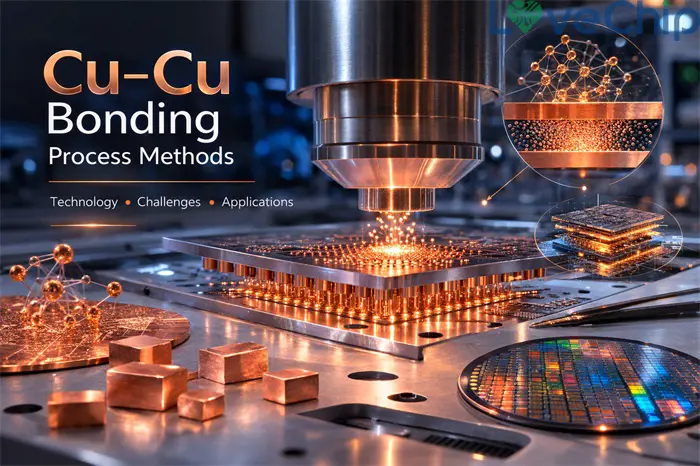
What follows is a closer look at direct cu-cu hybrid bonding eliminates micro-bumps in high-bandwidth memory stacks — not as a product announcement, but as an engineering story with real consequences for the semiconductor supply chain.
The physical scaling of vertical high-bandwidth memory
The physical scaling of vertical high-bandwidth memory (HBM) stacks has encountered strict electrical and mechanical barriers imposed by traditional solder micro-bumps, which exhibit high parasitic resistance and pitch limitations when scaled below ten micrometers. Memory manufacturers have transitioned to direct copper-to-copper (Cu-Cu) hybrid bonding, fusing oxide dielectric surfaces and embedded copper pads simultaneously at the atomic level without intermediate solder interfaces.
Hybrid bonding replaces bulky solder bumps with
Hybrid bonding replaces bulky solder bumps with nanoscale copper interconnects embedded within a dielectric matrix. When two prepared silicon dies or memory wafers are pressed together under controlled temperature and pressure, copper atoms diffuse across the interface while the surrounding oxide layers form covalent bonds. This creates a continuous, monolithic electrical and mechanical connection across all stacked tiers.
SK Hynix: The elimination of solder micro-bumps
The elimination of solder micro-bumps enables a dramatic reduction in vertical stack height, allowing packaging engineers to integrate more memory layers within standard JEDEC package thickness envelopes. Furthermore, the denser interconnect pitch allows for thousands of parallel data channels, boosting memory bus bandwidth while lowering capacitive power loss.
Enterprise hardware evaluations confirm that?
Enterprise hardware evaluations confirm that hybrid-bonded memory stacks exhibit superior thermal dissipation characteristics, as direct metal-to-metal contact conducts heat away from active memory cells much faster than polymeric underfill and solder joints. As AI accelerator memory bandwidth demands soar, hybrid bonding has established itself as an essential packaging standard.