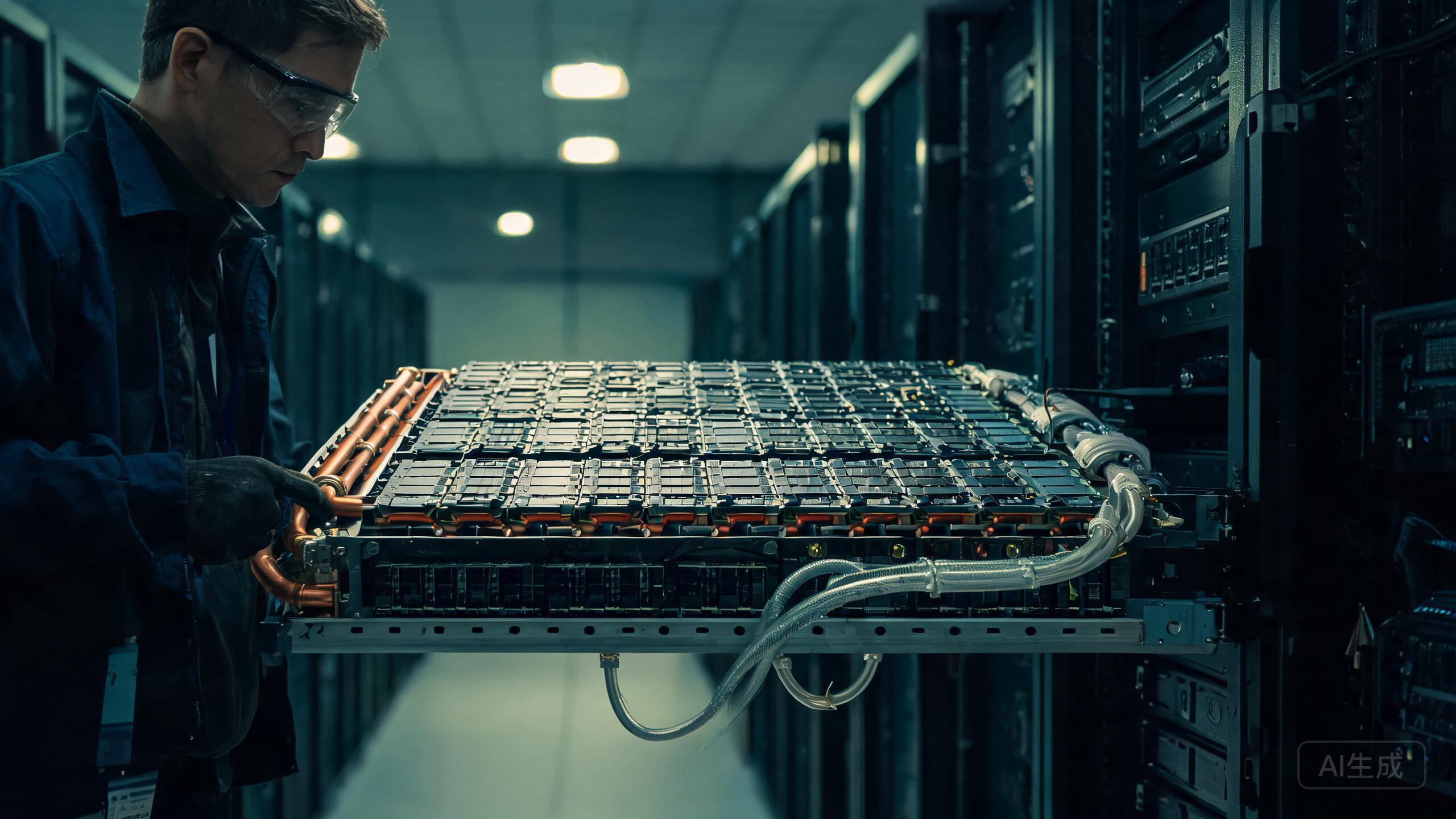
AMD has begun customer shipments of Helios, the rack-scale platform built around its MI450-series accelerators. Each rack carries 72 GPUs and exposes 31 terabytes of combined HBM4 capacity, making it the company's most serious attempt yet to compete at the level of an entire AI cluster rather than a single board. The first deployment commitments include a one-gigawatt tranche of the OpenAI agreement announced last year, alongside cloud operators testing the platform for inference fleets.
The MI450 package is manufactured on TSMC's 2nm
The MI450 package is manufactured on TSMC's 2nm process and combines compute chiplets with separate I/O dies and 12-high HBM4 stacks. Each GPU carries 432GB of memory and about 19.6 TB/s of bandwidth, figures that put it in the same class as NVIDIA's Rubin while leaving room for a larger memory configuration in the MI450X variant. AMD's design philosophy favors standard high-bandwidth memory over proprietary packaging, which makes second-sourcing easier but shifts more of the performance burden onto the interconnect.
AMD: That interconnect is UALink, the open
That interconnect is UALink, the open scale-up fabric AMD helped define with Broadcom, Cisco, and several hyperscalers. Helios uses UALink over copper for short reach and supports 256 links per rack, but the ecosystem is younger than NVLink and interoperability testing has consumed a large share of the qualification schedule. The rack itself follows Open Compute Project mechanical standards, which lowers the barrier for operators that already run OCP hardware but also exposes AMD to comparisons with every other vendor in that ecosystem.
ROCm 7 has matured enough that the software gap?
ROCm 7 has matured enough that the software gap is narrower than it was two generations ago. PyTorch, vLLM, and SGLang all run on the platform, and AMD has contributed kernel work upstream instead of relying on a proprietary fork. The remaining friction is in the long tail: obscure operators, custom attention variants, and multi-node collectives that still require hand tuning. Customers evaluating Helios consistently describe software readiness, not silicon, as the deciding factor.
AMD's commercial bet is that hyperscaler
AMD's commercial bet is that hyperscalers want a second source and that open interfaces will eventually win the same way Ethernet displaced proprietary fabrics in networking. That bet is plausible but not yet proven. Helios will be judged on sustained large-cluster availability, firmware stability, and whether UALink can support the 576-accelerator domains that the next generation of models will demand. If those tests pass, the AI accelerator market will look meaningfully more competitive by the end of 2027.
"AMD has begun shipping Helios, a 72-accelerator rack built around the MI450 series with 432GB of HBM4 per GPU, aimed at hyperscalers that want an open alternative to NVIDIA's NVL72." — Reuters